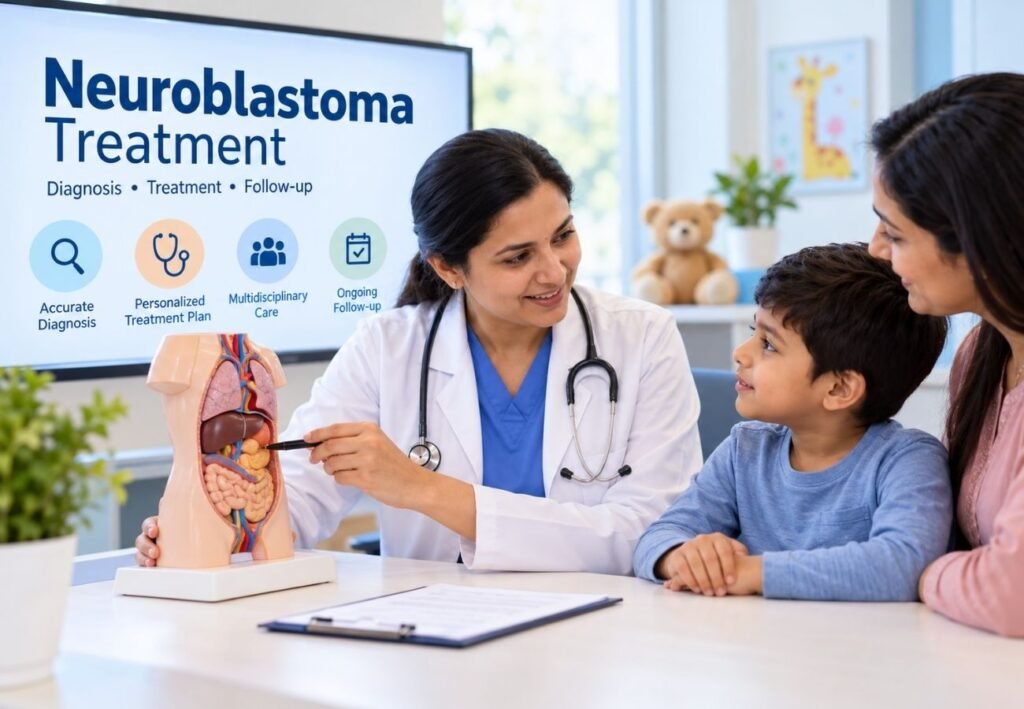
Neuroblastoma is a cancer that develops from immature nerve cells called neuroblasts and mainly affects children. The treatment plan is different for every child and depends on factors such as age, stage, risk group, tumour biology, location and response to treatment.
Neuroblastoma treatment may involve surgery, chemotherapy, radiation therapy, immunotherapy, stem cell-based treatment or other therapies, depending on the child's condition. Surgery can play an important role, but it is planned as part of the child's overall cancer treatment.
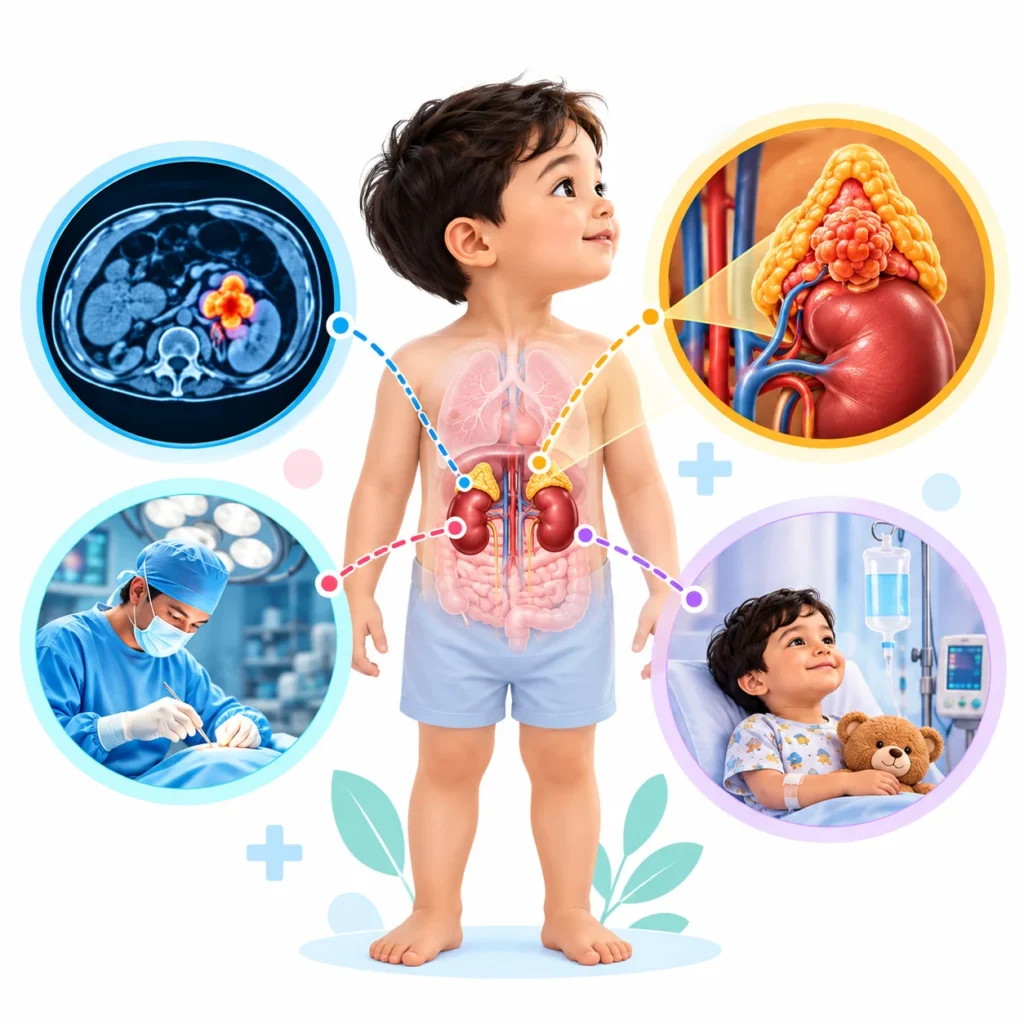
Neuroblastoma develops from immature nerve cells and commonly starts in the adrenal glands, which are located above the kidneys. It can also develop in other parts of the body along the sympathetic nervous system.
The symptoms can vary depending on where the tumour develops and whether it has spread. Some children may have a lump or swelling, while others may develop symptoms related to pressure on nearby organs or structures.
The treatment approach depends on the characteristics of the tumour and the child’s overall condition.
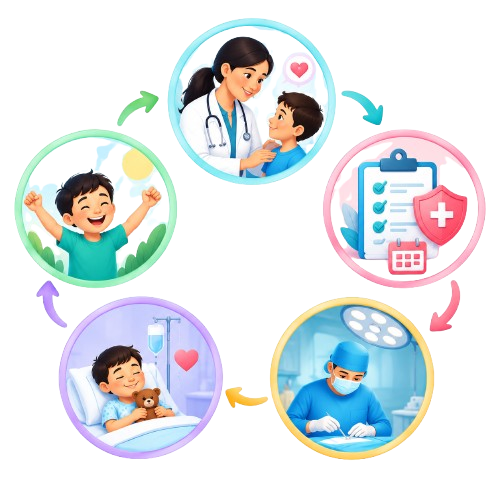
There is no single treatment plan for every child with neuroblastoma. Doctors first assess the disease and determine the child’s risk group before planning treatment.
Depending on the child’s risk group and clinical situation, treatment may include:
Some children may need only one treatment approach, while others may require a combination of treatments. The order in which treatments are given is also important.
For example, chemotherapy may be given before surgery in some children, while surgery may be considered earlier in others. The decision depends on the tumour’s characteristics, location and how safely it can be removed.
The treatment plan is based on several clinical and biological factors, not just the size of the tumour.
Doctors may consider:
These factors are used to determine the child’s risk group. Neuroblastoma is generally classified as low risk, intermediate risk or high risk. The risk group helps the treatment team determine the type and intensity of treatment that may be appropriate.
This is why two children with neuroblastoma can have very different treatment plans.
Surgery can have different roles during neuroblastoma treatment.
It may be used to obtain tissue for diagnosis or to remove the primary tumour when this can be done safely. The timing and extent of surgery depend on the child’s disease and the relationship of the tumour to nearby organs, blood vessels and nerves.
In some children, surgery may be performed early in treatment. In others, chemotherapy may be given first to reduce the tumour before surgery.
The goal is to remove as much of the tumour as can be safely removed while protecting important surrounding structures. If complete removal is not safe or possible, leaving some tumour behind does not automatically mean that treatment has failed. Further treatment depends on the child’s risk group and overall treatment plan.
Some children receive chemotherapy before surgery. This may help reduce the tumour and potentially make surgical removal more feasible.
After chemotherapy, the child’s scans and clinical response are reviewed. The surgical team then reassesses the tumour and determines whether surgery is appropriate and how it should be performed.
Chemotherapy before surgery is not required for every child. Its use and timing depend on the child’s risk group, tumour characteristics and treatment plan.
The location of a neuroblastoma and its relationship with nearby structures are important when planning surgery.
Doctors review imaging such as CT or MRI scans to understand the tumour and assess its relationship with important structures. They may also consider image-defined risk factors, or IDRFs, which can indicate that a tumour may be more difficult to remove safely.
IDRFs can include involvement of major blood vessels, nearby vital structures or other features seen on imaging.
The presence of an IDRF does not automatically mean that surgery cannot be performed. Instead, these findings help the treatment team understand the surgical complexity and plan the most appropriate treatment approach.
Minimally invasive techniques, such as laparoscopic or thoracoscopic surgery, may be considered for selected children with neuroblastoma.
They are not suitable for every tumour. The size and location of the tumour, its relationship with surrounding structures and the child’s overall condition all need to be considered.
When appropriate, minimally invasive tumour surgery should be performed by a team with experience in pediatric surgical oncology.
Neuroblastoma is generally classified into low-risk, intermediate-risk and high-risk groups. Treatment differs between these groups.
Low risk: Observation and/or surgery may be appropriate for selected children.
Intermediate risk: Treatment may include chemotherapy, surgery or both, depending on the child’s clinical and tumour characteristics.
High risk: Treatment generally involves multiple treatment approaches, which may include chemotherapy, surgery, radiation therapy, high-dose therapy with stem cell rescue and immunotherapy.
These are broad treatment approaches. The exact plan is individualised based on the child’s disease characteristics, risk group and response to treatment.
Neuroblastoma can sometimes return after initial treatment. This is known as recurrent or relapsed neuroblastoma.
Treatment for recurrent disease depends on several factors, including the child’s original risk group, where the cancer has returned and which treatments have already been given.
For some children, surgery may be considered when recurrent disease is located in an area where it can be safely removed. Other children may need chemotherapy, radiation therapy, immunotherapy or other treatments. The appropriate approach needs to be assessed individually by the child’s cancer team.
Follow-up is an important part of care after treatment.
The follow-up plan depends on the child’s diagnosis, treatment received and risk of recurrence. It may include clinical assessments, imaging or other tests when appropriate.
Follow-up also considers possible long-term effects of cancer treatment and the child’s ongoing health and development. Parents should follow the monitoring plan recommended by their child’s treating team.
Neuroblastoma treatment often involves more than one medical speciality.
A child’s care may involve pediatric surgical oncology, pediatric medical oncology, radiology, pathology, radiation oncology, pediatric anesthesia and critical care, along with other supportive services when needed.
These specialists work together to understand the diagnosis, assess treatment response and decide when surgery or another treatment should be used.
This means the surgical plan is considered as part of the child’s complete cancer treatment rather than as an isolated procedure.
Parents may consider a second opinion when they want another specialist’s view of their child’s diagnosis or treatment plan.
A pediatric surgical oncology consultation may be useful when surgery has been recommended, when the tumour is close to important blood vessels or other structures, when the timing of surgery is unclear, or when residual or recurrent disease is being considered.
A second opinion does not necessarily mean changing the treatment plan. It can help parents better understand the diagnosis, available options and role of surgery in their child’s care.
Families seeking a pediatric surgical oncology consultation in Mumbai can discuss their child’s diagnosis, previous treatment and possible surgical options with Dr. Monica Bhagat.
 Posted on Google
 Sweta Kalgude
Trustindex verifies that the original source of the review is Google.
We are so grateful for Dr. Monica Bhagat! She is an incredibly kind, caring, and cooperative doctor. She treated my child with so much love and gentle care, which meant the world to us during those anxious moments. She took the time to explain every detail of the treatment so we always understood what was happening, and she was always there to patiently answer our questions whenever we had doubts. Her hands-on expertise and warm heart gave us so much comfort. We highly recommend her to any family! ❤️Posted on Google Praveen SureshDr. Monica Bhagat is an exceptional oncology surgeon who combines extensive knowledge and experience with genuine empathy and compassion. She is courteous, patient, and takes the time to make you feel comfortable and heard. Her professionalism and caring approach really stand out. Highly recommended!Posted on Google
 Dipak PandeThank you for treating our child with so much love and care ...Posted on Google
 GOPAL KumarDr. Monica is the best pediatric oncosurgeon in Mumbai. She explains everything in a very easy language. Highly recommended 💯Posted on Google
 Ravi FuleriyaDr. Monica is an good surgeon, really supportive and nice explanation, thankyouPosted on Google
 Vaibhav PataniWe consulted Dr. Monica Bhagat in Mumbai and had a really good experience. She is a very patient and approachable pediatric oncosurgeon. She explained everything clearly and answered all our questions without rushing us. Very thankful for her guidance and support.
Bring the child's pathology or biopsy reports, scan reports and previous treatment records. If the child has already received chemotherapy, surgery or another cancer treatment, treatment summaries and relevant medical records can also help the specialist understand the child's medical history.
Yes. A specialist may review the available pathology report as part of a second-opinion consultation. If a further pathology review is needed, the family can be advised about the additional information or pathology material required.
Yes. A second opinion can be sought at different stages of treatment. Parents may want another specialist's opinion about the diagnosis, response to treatment, surgical options or the next step in care.
Some children with recurrent neuroblastoma may be evaluated for surgery. The decision depends on where the disease has returned, its extent, previous treatment and whether the recurrent tumour can be safely removed.
Parents may want to ask about the child's diagnosis and risk group, the purpose and timing of surgery, how surgery fits into the overall treatment plan, possible alternatives and what follow-up may be needed. Writing down questions before the appointment can help families make the most of the consultation.
International families can contact the practice to enquire about consultation and treatment planning in Mumbai. Sharing relevant medical records before travelling can help the medical team understand the child's diagnosis and previous treatment history.
If your child has been diagnosed with cancer or a tumour, a specialist consultation can help you understand the diagnosis and treatment options. Dr. Monica Bhagat provides international pediatric surgical oncology care for children with cancer and solid tumours.
Discuss your child's condition, whether surgery may be appropriate, and the next steps in care
Dr. Monica Bhagat
Typically replies within minutes
Any questions related to Neuroblastoma Treatment?
WhatsApp Us
Online | Privacy policy
Plot No. 8, PU04, Commercial Scheme 54, Rasoma Square, Vijaynagar, AB Road
Plot No. 8, PU04, Commercial Scheme 54, Rasoma Square, Vijaynagar, AB Road